

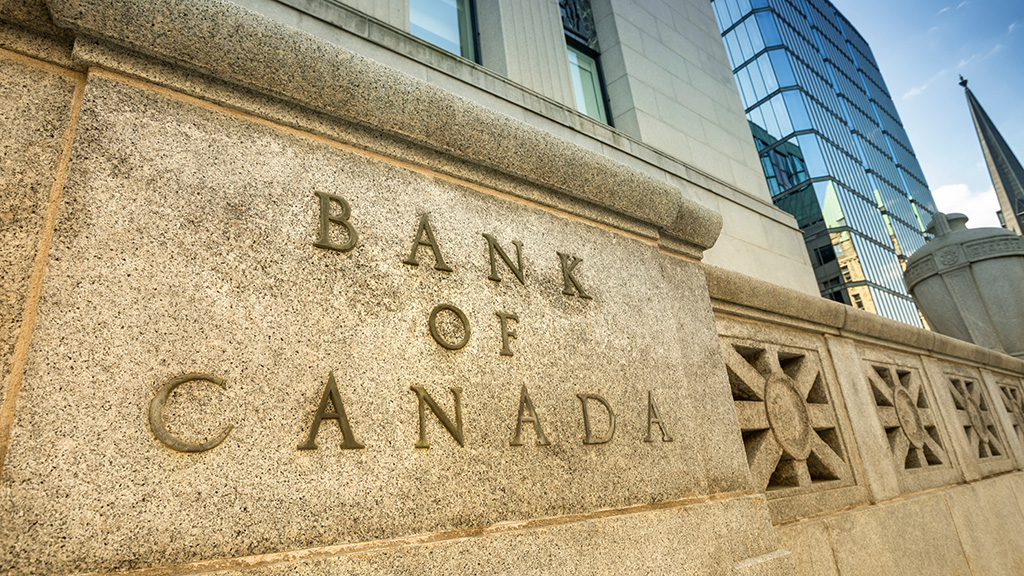
OTTAWA — The Bank of Canada held its benchmark interest rate steady for a fourth consecutive time Wednesday, but officials warned uncertainty over the war in Iran and the future of U.S. tariffs could push the policy rate either higher or lower in the coming months.
The policy rate remains at 2.25 per cent after the hold, which was widely expected by economists.
Bank of Canada governor Tiff Macklem spoke after the rate announcement, where he offered rare insight into the variety of directions the policy rate could go from here.
Macklem said the key rate is probably at about the right level if the economy follows the central bank’s projections, though he didn’t rule out future adjustments depending on how the risks play out.
“If the economy evolves broadly in line with the base case, changes in the policy rate can be expected to be small,” he said.
“However, uncertainty is unusually elevated and there are many possible outcomes. Monetary policy may need to be nimble.”
The Bank of Canada identified two clear sources of lingering uncertainty in its updated outlook released alongside the rate decision Wednesday: the war in Iran’s effects on energy prices; and the outcome of the upcoming review of the Canada-U.S.-Mexico trade agreement.
If the United States hits Canada with sharper trade restrictions in the wake of the review, Macklem said the bank may need to cut the policy rate further to support the economy.
But if the Iran war pushes global energy prices higher for longer, Macklem said the central bank may be forced to tighten monetary policy — throttling growth to keep a lid on inflation.
“If this starts to happen, monetary policy will have more work to do — there may be a need for consecutive increases in the policy rate,” he said.
Speaking to reporters Wednesday, Macklem said today’s uncertainty is unusual because it’s tied to geopolitical events — something the central bank can’t assign probabilities to.
He was asked what the central bank would do if Canada faced steeper tariffs and a sustained increase in global oil prices at the same time, but he would only offer a general answer.
“What we’re trying to convey is the direction and the rough magnitude of how we would respond given certain situations,” he said.
“Obviously, if it’s a combination, it’s going to be even more complicated. And we’ll have to weigh the various factors.”
Macklem also did not offer a timeline for how long oil prices would need to stay elevated for the Bank of Canada to respond with rate hikes, saying it would depend on how the energy price shock was showing up in the inflation data.
Statistics Canada reported a jump in the annual inflation rate to 2.4 per cent in March thanks mostly to a surge in gas prices.
The Bank of Canada’s outlook assumes global oil prices ease from around US$100 per barrel currently to US$75 per barrel by mid-2027. Macklem said, in that scenario, the central bank sees inflation peaking around three per cent in April before cooling back toward the bank’s two per cent target by early next year.
He said there’s little sign yet that higher oil prices are feeding through to broader inflation, but monetary policy-makers will be watching for changes in inflation expectations closely in the months ahead.
“If we’re in a situation where the shock is bigger — in particular, is more persistent — and we see growing evidence of propagation, that would be a clear signal that, yes, rates probably do need to go higher to get inflation back to target,” Macklem said.
The bank’s monetary policy report noted that the federal government’s move to pause the fuel excise tax until Labour Day will help “cushion part of the increase” in inflation from higher gas prices.
But the report also warns that rising fertilizer prices could put pressure on agricultural costs in the months ahead. That could fuel more increases in already stubborn food inflation, the bank warns.
CIBC chief economist Avery Shenfeld said in a note to clients Wednesday that the decision to hold the rate steady “came as no surprise given the clouded outlook.”
He said the Bank of Canada’s decision to highlight the possibility of both rate hikes and cuts implies the bank is prepared to remain on the sidelines for now.
Despite the uncertainty, the Bank of Canada’s baseline forecast for growth hasn’t changed much from its last outlook in January. It sees real gross domestic product growing at 1.2 per cent this year and 1.6 per cent in 2027 — both a tick higher than in the January forecast.
Higher global oil prices tend to give Canada’s economy a lift, at least in the near term, because the country is a net exporter of energy. But higher prices at the pump also constrain consumers and many businesses, which can offset any gain in GDP.
The Bank of Canada’s latest outlook does not incorporate spending plans released by the federal government on Tuesday in the spring economic update.
©2026 The Canadian Press
Recent Comments
comments for this post are closed