


Modular construction processes, whether factory-produced components or full volumetric units, address a number of the industry’s most pressing challenges.
These include enhancing the sector’s productivity, reducing manpower requirements by up to 40 per cent, accelerating project timelines by up to 50 per cent, and enabling cost savings.
Canada has been a relative laggard when it comes to residential modular construction due to a number of systemic issues. Fortunately, actions being taken by the federal government are shining a positive light for the future.
Currently, the majority of players operating in modular construction are still focused on relatively straight forward projects, such as low height buildings that require limited geometric or technical complexity, centred around a project-based sales model, says McKinsey Global in its report titled .

Bringing output up to mass production levels is another major challenge that McKinsey identifies.
“Many recent shortcomings in modular construction are linked to a lack of focused scaling. Companies may build large, automated factories without sufficient demand to fill production lines or scale into new geographies before first establishing themselves in one market. Companies should ensure there is sufficient, stable demand before expanding capacity— and be considerate of payback times,” the report continues.
“Construction, especially modular, can be capital-intensive and even a single suboptimal project can jeopardize a company’s success.”
Leith Moore, principal and co-founder of Toronto-based modular builder Assembly Corporation, agrees the Globe & Mail, “If you have a plant, the challenge is keeping it full, it’s gotta keep moving. Where is the pipeline? Our new plant is going to cost $20 million. To do that, you need a consistent supply (of orders).”
As an example, lack of sufficient scaling was identified as an important factor leading to the of Hamilton-area modular homebuilder BECC Construction last July, where creditors were seeking repayment of more than $17-million.
McKinsey suggests in order to mitigate risks and recognize the scaling issue, it is important for modular companies to build direct connections with real estate players in order to create secure demand.
Government initiatives can also significantly influence the modular construction industry by addressing various challenges.
High levels of modular production scaling through government participation are particularly evident in Sweden where the national government plays a strong hand. The result is 84 per cent of all residential homes being built with prefabricated elements. In comparison, less than five per cent of Canadian residences are built that way.
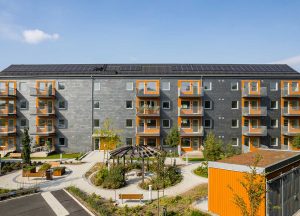
Part of the problem in Canada surrounds not just the homebuilding industry’s long-standing resistance to change and certain regulatory bottlenecks on the supply side but also market preconceptions on the demand side.
“In Canada, when you say ‘prefab,’ people think of a trailer park or small houses built after the war,” Simera Negeri, a consultant for Swedish export promoter ÈȵãºÚÁÏ Sweden, LaPresse.
The good news is the transformation of Canada’s residential modular construction industry is within sight.
In September, Prime Minister Mark Carney announced the creation of Build Canada Homes, a new $13 billion, federally-funded agency created to build affordable housing at scale.
“Build Canada Homes will deploy capital, create demand and harness innovative housing technologies to build faster and more sustainably, 365 days a year,” the PM’s Office said in its .Ìý“Build Canada Homes will place an intense focus on using cost-efficient and modern methods of construction such as factory-built, modular and mass timber.”
The agency will also take advantage of public land sites under Canada Lands Company’s portfolio. It has already prioritized federal sites in Dartmouth, Longueuil, Ottawa, Toronto, Winnipeg and Edmonton to build 4,000 factory-built homes, with additional capacity of up to 45,000 units across its portfolio. The government itself will lead these developments with a “direct-build” approach, overseeing and leading construction projects focused on affordable mixed-income communities.
Encouraging signs are coming from the real estate investment community as well.
According to anonymous sources referenced by both and , talks are advancing between Singapore’s sovereign wealth fund GIC and Brookfield Asset Management concerning the US$10 billion sale of GIC’s stake in .
Yes Communities owns nearly 300 manufactured home communities and more than 55,000 housing sites across the United States. Brookfield is a Canadian global conglomerate that oversees over US$1 trillion of assets across several sectors, including more than US$270 billion in real estate.
The global modular construction market will experience significant growth, Overall, it projects the global market growing to US$150 billion by 2035, with the North American residential modular market increasing from US$35 billion in 2024 to US$50 billion by 2035. It sees increased public-private partnerships playing a significant role in global modular activity.
John Bleasby is a freelance writer. Send comments and Inside Innovation column ideas to editor@dailycommercialnews.com.







Recent Comments
comments for this post are closed