

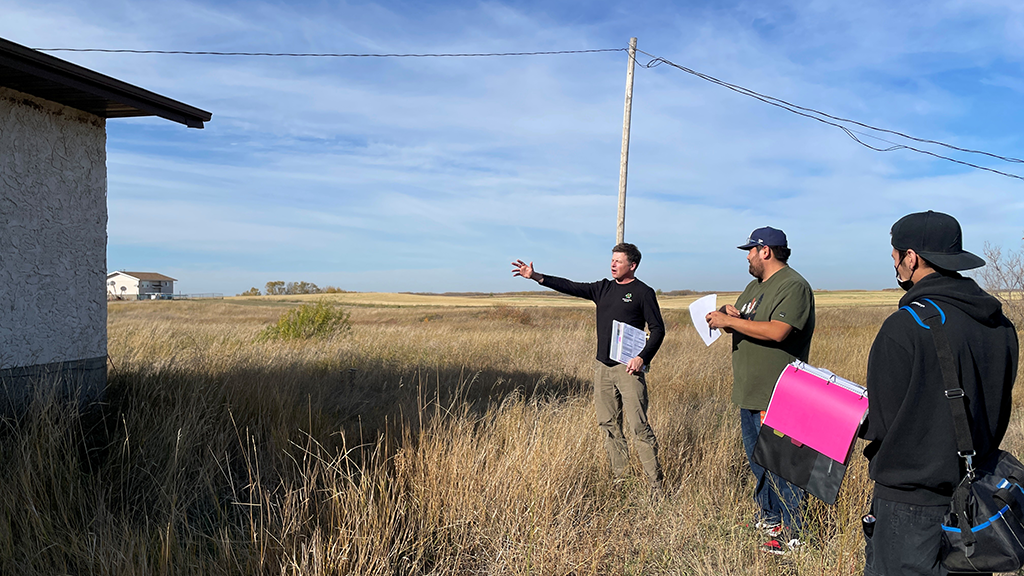
The logistics of co-ordinating housing retrofit projects on First Nations lands is often complex and challenging.
A retrofit project might have several funders, each with its own requirements. The chief and council also have demands to meet, ditto the local housing department and the building trades.
All combined, it can result in time-consuming delays at a time when housing needs are pressing.
Tim McCormick has overcome many hurdles during his seven year-span at Community Power, a division of Kambo Energy Group, where he has been involved in more than 150 projects on various First Nations lands primarily in northern B.C. but also in Alberta and Saskatchewan.
A case in point is a 23-home renovation and energy retrofit in a remote B.C. community. To solve a common problem – where to house construction workers during the multi-month makeover – McCormick’s team salvaged a house slated for demolition, had its crew renovate it and then live in it during the rest of the 23-home renovation and energy retrofit program.
McCormick, the senior manager of partnerships and project design at Community Power, says it not only saved money on shipping up temporary housing, it added another renovated home to the community.
McCormick spoke about some of the challenges as a panellist at a seminar on Indigenous Leadership in Housing and Building Innovation at the Retrofit Canada Conference in Toronto.
Project delays can be common. Over a seven-month energy retrofit delay because of a funding issue, one house in the community became uninhabitable, another burned down and a third was abandoned and taken over by squatters.
“They (one of the financial backers) were creating bureaucratic red tape delays to the point where it was affecting lives in the community.”
McCormick, who operated his own construction company for about 10 years of his more than 25-year construction career, has been with Kambo, a certified minority-owned social enterprise in Canada, for about seven years. His work is exclusively for indigenous communities.
He says energy retrofits can be tricky to get right in the north.
“If you seal a building envelope where there was a small mold problem it could be exacerbated, leading to a true health concern for the residents,” he explains.
Mold is a common problem in northern homes, stemming partly from the extreme climate, poor ventilation and in some cases overcrowding due to a lack of housing.
McCormick says he is pleased First Nations housing concerns are starting to get more attention for many sources. At the Retrofit conference the seminar had “first stage presence, rather than an afterthought (session) stuck in a back room.”
Trevor Norris, project manager of asset strategies with the Aboriginal Housing Management Association (AHMA), says planning projects requires a lot of creativity because the association works strictly with off-reserve housing which has fewer funding options, including through Indigenous Services Canada.
About 85 per cent of Indigenous peoples (including First Nations, Metis and Inuit) in Canada live off-reserve, he says.
While the AHMA has reliable funding partners such as BC Housing, the CMHC and various utility companies and private corporations, Norris says “there is still a never-ending challenge in stacking funding to improve the quality of life of Indigenous peoples living in below-market housing.”
He says often overlooked is incorporating cultural elements and features into projects that go beyond superficial treatment.
Resident engagement early in the planning stage is paramount. He cites an example where the association replaced a building envelope for a four-storey apartment in Vancouver incorporating culturally appropriate colours and design. The project also features Indigenous art in the front lobby.
The AHMA also used incentives and grants for mechanical/electrical systems and window and door upgrades to redesign the amenity room, turning it into a cultural hub for residents.
“I’m a firm believer that health, both physical and mental, starts at home. In doing all of this, we’re able to address energy efficiency and culture together, creating a healthier, happier living space for Indigenous peoples living off-reserve across British Columbia,” Norris says.
Recent Comments
comments for this post are closed