

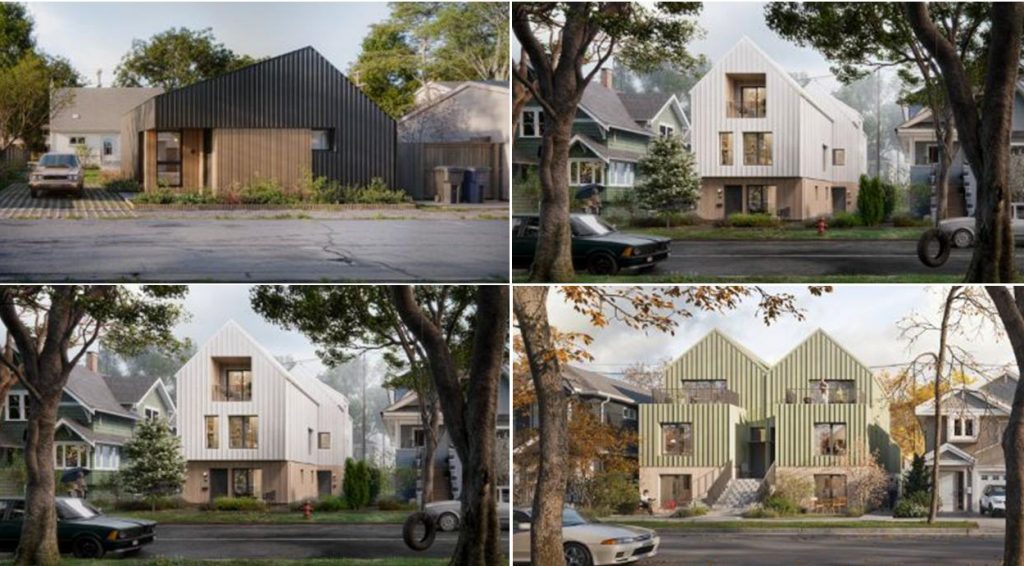
The Canada Housing Design Catalogue was a concept born out of the latter days of the Justin Trudeau administration that recalled the Canada Mortgage and Housing Corporation (CMHC) catalogues of home designs first published in 1947.
The idea was taken up by the new Liberal government, with renderings released in March. In the meantime, the homebuilding industry has been waiting for details. This week, detailed construction plans became available for .
The focus of the standardized designs is on the gentle densification of existing urban areas rather than on greenfield development.
“This catalogue is designed to streamline building and encourage the kind of gentle density we urgently need, while taking into account local and regional needs throughout Canada,” said Tim Louis, Kitchener – Conestoga MP.
Among the 50 individual designs offered are multiple choices for accessory dwellings for existing lots, duplexes and multi-plexes, offering contemporary appearances that should blend with established neighbourhoods.
Each design is suited to specific areas of Canada, based largely on climatic differences as well as code variations.
In its , the Ministry of Housing, Infrastructure and Communities listed more than a dozen municipalities across the country that have already committed to supporting the catalogue by pre-reviewing designs to help streamline approvals. It is hoped many more will now join them.
“The Housing Design Catalogue is part of a broader set of measures by the federal government to double the rate of housing construction, restore affordability and reduce homelessness,” CMHC says.
In this way, the new catalogue meshes with the recently announced $13 billion federally-funded agency Build Canada Homes.
The new agency intends to drive “the building and financing of affordable housing at scale, while catalyzing a more productive homebuilding industry, with a clear emphasis towards prefabrication and modular construction.”
On the other hand, the concept of the Canada Housing Design Catalogue is more bespoke and based on traditional wood frame construction and does not raise the bar in terms of construction processes.
The expressed intent is to support local jobs and supply chains that look to Canada’s forestry industry. It is anticipated with the release of full technical design packages, time, money and red tape can be reduced during the design and approval process.
As had been hoped by energy efficiency experts, the building packages of each design in the catalogue go beyond construction detail and include Building Performance Reports. These reports detail projected operational energy use, and offer assumptions concerning embodied and whole life carbon, as developed by Ha/f Design, Acorn Sustainability Consulting and CarbonWise.
However, targets for operational energy efficiency fall short of PassivHaus Standards, which may disappoint some industry observers.
Instead, projections are based on what are described as, “a prototypical design which targets NBC 2020 – Tier 3 energy performance,” with consideration given to project location and orientation. Although air tightness of the final envelopes would require third party verification, a target of 2.5 ACH has been set.
Further assumptions have been made concerning matters such as HVAC systems and whether natural gas or electricity is used.
With the Canada Housing Design Catalogue specifications now available, it is expected the housing industry across Canada will offer reactions and feedback.






Recent Comments
comments for this post are closed