

The Government of British Columbia announced recently that construction of a new school to replace will begin in July 2026.
Thanks to an innovative construction approach, the school is slated to open by December 2027, which the province says would be at least a full school year sooner than would be possible using traditional building methods alone.
The total cost is expected to be just under $39 million.
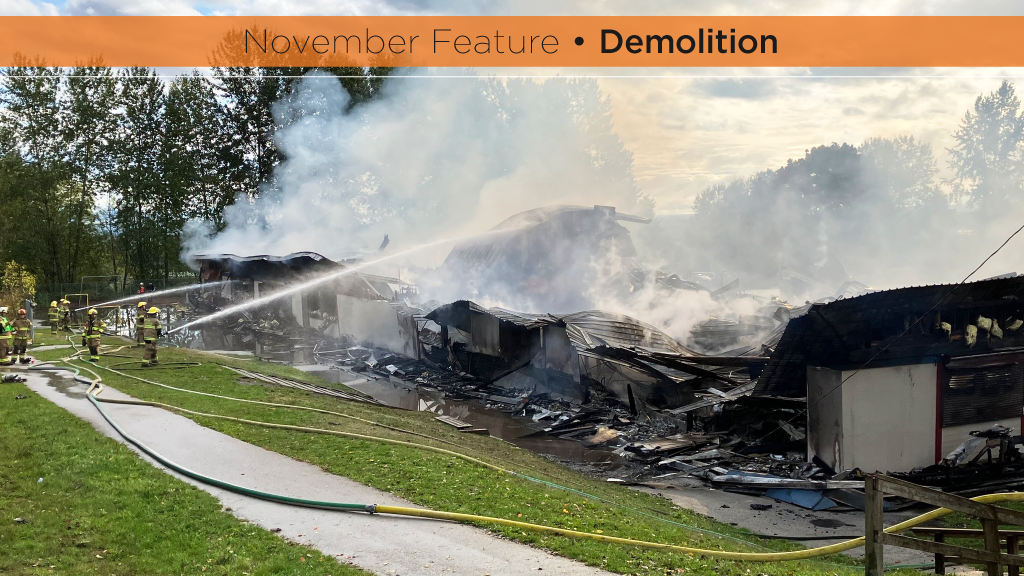
The school, located in the eastern Vancouver suburb of Port Coquitlam, was destroyed in October 2023 by a fire that was determined to have been intentionally set.
Since the fire, the displaced students and staff have been taken by bus every day to a makeshift campus at a former middle school about 20 minutes away, a logistical challenge for all concerned.
“Students in Port Coquitlam deserve to go to school close to home, and parents and families deserve the convenience that this brings,” said Mike Farnworth, the Port Coquitlam MLA, in an announcement. “After the loss of Hazel Trembath Elementary in our community, we know the rebuild can’t come quickly enough for families, and our government is working urgently to deliver a new school that will welcome students back as soon as possible.”
The new school, which will occupy the school’s original site, will be the first in B.C. to be built according to a hybrid construction model.
The classrooms and common areas will be built using prefabricated materials, while the gymnasium will follow conventional construction techniques.
The new school will have two kindergarten classrooms, eight elementary classrooms and a neighbourhood learning centre that could support future child care spaces.
It will also have a high-efficiency heat pump that the government says will cut greenhouse-gas emissions by about 50 per cent as well as parking equipped with electric vehicle charging stations.
Minister of Infrastructure Bowinn Ma says the new school will have a capacity of 240-seats, a little fewer than the original school’s 290 seats.
Ma says the province decided on the hybrid construction model because it wanted to get the students into a new school as soon as possible.
“While a school built using traditional methods would typically take three to five years, we anticipate this school will be complete in two years, or even sooner,” says Ma.
Contracts have yet to be issued for the project.
“The business case was just approved (in October 2025),” says Ma. “The school district will go through a competitive tendering process for the project to select a general contractor.”
Ma says the government intends to build new schools in the future using its approach in Port Coquitlam.
“The Ministry of Infrastructure is streamlining the way we build schools, hospitals and post-secondary facilities. By bringing planning, procurement and delivery of large capital projects under one roof, the ministry will enable smarter, faster and more cost-effective infrastructure across the province.
“This includes the continuation of prefabricated additions at schools to address enrolment pressures as well as hybrid construction of new schools, where appropriate.”
The innovative approach to replacing Hazel Trembath Elementary was made possible by the passage of B.C.’s Infrastructure Projects Act (Bill 15) in May 2025, which created the new Ministry of Infrastructure.
The act addresses delays in permit reviews for projects that have secured funding.
The legislation also applies to projects that have been designated as “provincially significant.”
“The ministry is responsible for capital projects that are funded by the province in facilities that are operated by the public sector, such as schools and hospitals,” says a ministry spokesperson. “It is not responsible for roads, wastewater, community halls or other local infrastructure.”
The spokesperson says the ministry has a number of tools at its disposal that can be used to address roadblocks and get shovels in the ground faster, including:
- Prioritizing provincial permits;
- using qualified professionals for permit reviews;
- developing an expedited environmental assessment process;
- allowing for the grouping of similar projects for more efficient procurement; and
- giving local governments more flexibility with their community planning requirements and supporting local government decision-making.








Recent Comments
comments for this post are closed