

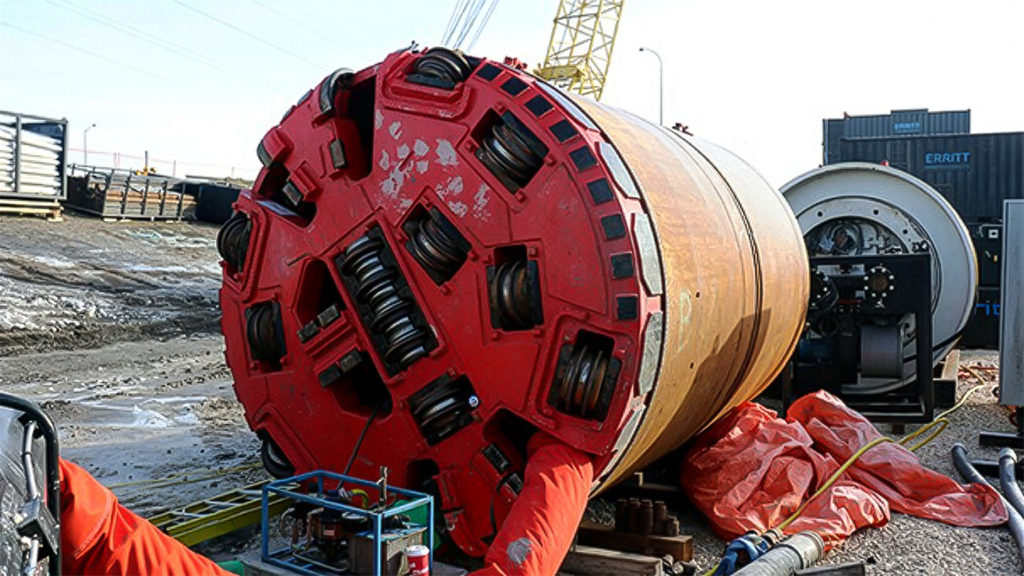
WINNIPEG – It’s not every day a project requires a micro tunnel boring machine to drill deep below Manitoba’s Red River as part of critical sewer pipe repairs.
According to the City of Winnipeg, under the streets and rivers are a series of sewer pipes that take wastewater from homes and businesses to treatment plants.
The sewer pipe crossing under the Red River near the Fort Garry Bridge failed in 2023. While a temporary above ground bypass was put in place in 2024, allowing the wastewater to keep flowing to the plants, a new permanent repair was needed.
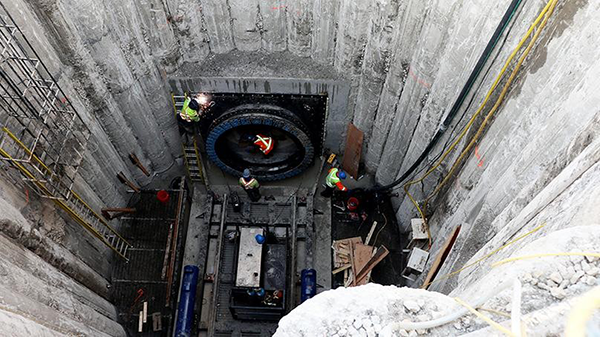
“This work requires highly specialized equipment and incredibly skilled equipment operators,” the city writes. “Installing pipes on a vertical curve that moves through various ground conditions is also very complicated.”
Ryan Lucky, a design and specification engineer with water and waste, says it is “tricky to enter the bedrock through mixed soils and you need a contractor who knows what they are doing. Only a handful of them can do this type of work in North America.”
To do the work, the micro tunnel boring machine was lowered 17 metres down into the earth. Recently, it started drilling a roughly 2.4-metre-wide tunnel underneath the river.
“Microtunneling is ideal for installing large sewer pipes over long distances, under both existing infrastructure and environmentally sensitive areas like waterways,” said Lucky. “It allows us to install the pipes without disturbing the Red River.”
The machine digs a tunnel with a rotating cutter head that grinds soil and rock, turning it into a slurry. That slurry is then carried through the pipes back to the surface where the debris gets filtered out, and eventually it is able to be reused, the city notes.
The machine is working 24 hours a day in two 12-hour shifts, for a total of 18 days. Hydraulic jacks will push it through a path underneath the water. Eventually it will make its way upward toward the sewer connection on the other side.
The machine travels about 1.25 metres per hour and is operated remotely by employees on the ground.
The boring machine is also pushing a casing pipe forward through it. Then, the two wastewater carrier pipes will be pulled into that casing pipe, the city explains. That will carry sewage across the river.
The new crossing is anticipated to be in service this summer. The bypass pipe that was installed in 2024 will then be able t be removed and the city will be able to lift the traffic restrictions near the bridge on Abinojii Mikanah.

Recent Comments
comments for this post are closed