

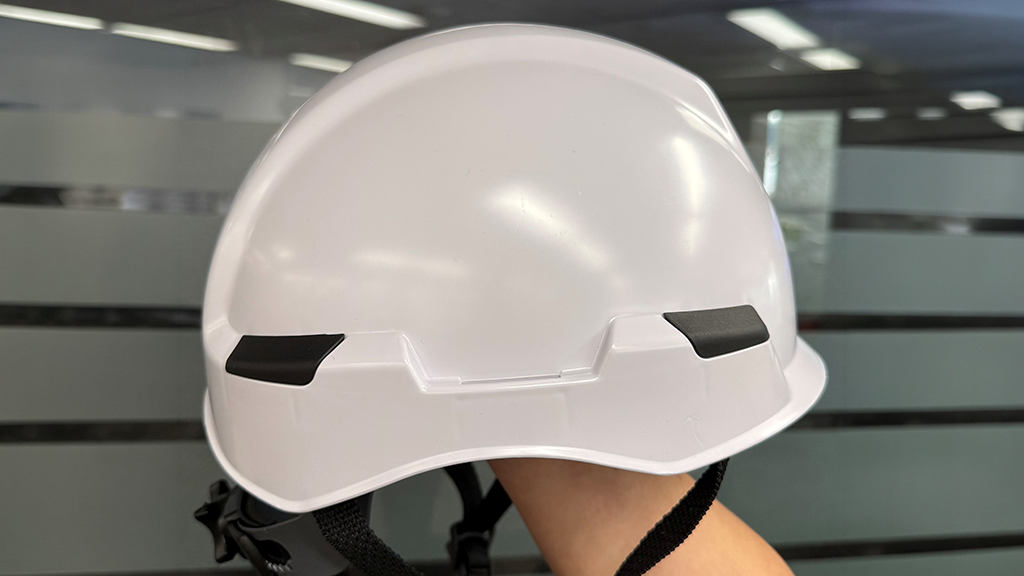
Canada’s largest construction employers are mandating Type II protection for employees and trade partners by July 1, 2026.
Regulations often develop slowly, while employers can act quickly to promote worker safety. One private sector initiative that’s gaining momentum is the use of Type II helmets — not through regulation, but through corporate mandates by large construction employers.
Last year, the Canadian Construction Safety Council (CCSC), an organization representing a dozen of Canada’s largest construction companies, said it would mandate the use of CSA or ANSI-certified Type II helmets in 2026. That mandate now has a hard stop, July 1, and extends to all workers employed by CCSC members, their trade partners and site visitors.
Here’s the reason for the new policy. Type I helmets are only designed to reduce force as a result of an impact to the top of the head. Type II helmets with an integrated, manufacturer-approved four-point chin strap are designed to reduce force as a result of impacts to the front, back, sides and top of the head.
The U.S. National Institute for Occupational Safety and Health traumatic brain injuries account for approximately 25 per cent of all construction-related fatalities, over half of which result from falls, mostly from ladders, roofs and scaffolding. Other causes include falling objects and struck-by incidents.
“Research shows that Type II helmets, especially those with integrated retention systems, offer greater protection and help reduce the risk of serious or fatal head injuries,” says Peter Lineen, executive vice-president, health, safety and environment with CCSC member Bird Construction.
That’s not a surprise, because the integrated chin straps featured in Type II helmets help them stay in place during slips, falls and high winds, or while workers are working in awkward positions.
A recent by the Helmet Lab at Virginia Tech reveals a shift to Type II helmets reduces average risk for fall-related concussions by 34 per cent and for skull fractures by 65 per cent.
Type II helmets are considered acceptable under regulations in all Canadian jurisdictions, although there may be specific requirements for either ANSI or CSA certification. A wide selection of products can meet those specs for employers making the switch.
“We believe that Type II helmets are the safest option for our employees and those of our trade partners,” says Lineen. “We also encourage all industry organizations, including individual employers, to join the CCSC in mandating Type II helmets with an integrated chin strap for their employees on construction sites across the country.”
Mike McKenna is executive director of the British Columbia Construction Safety Alliance, which is also a member of the Canadian Federation of Construction Safety Associations. He says safety associations have an important role to play, not only in assisting employers to be in conformance, but also in encouraging them to seek out the most effective personal protective equipment available to their workers.
“New research continues to identify Type II helmets as the safer helmet design for construction, with improved outcomes for those who use them,” he says. “As British Columbia’s industry safety association, we encourage our members to look at the research and support them in making an informed choice in favour of Type II helmets to protect their workers and also those workers employed by their trade partners.”
This content is an Industry Special by BCCSA in collaboration with ÈȵãºÚÁÏ™ Media.







Recent Comments
comments for this post are closed