

Although mass timber is widely praised for speedy, low-carbon construction, not everyone has boarded that train yet.
Many people in construction still believe the risks of using mass timber – cost, supply chain, trades, maintenance – outweigh the benefits.
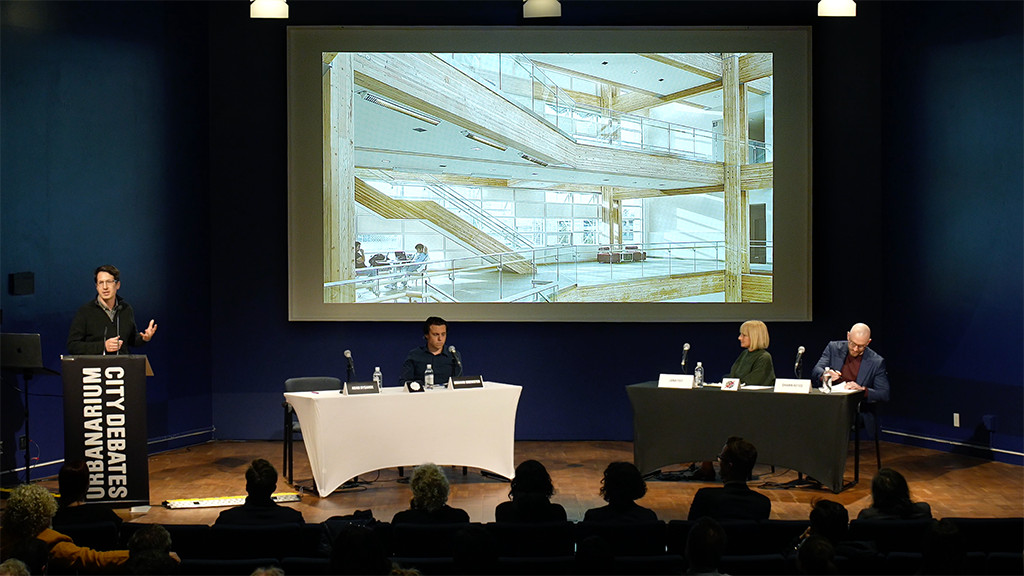
To shed some light on the subject, Urbanarium and the University of British Columbia School of Architecture and Landscape Architecture (UBC SALA) recently sponsored a debate in Vancouver on the proposition:
On the pro side (not worth the risk) were Adam Rysanek, an associate professor at SALA, and Graham Brewster, the senior director of development at Wesgroup Properties.
On the con side were Shawn Keyes, the executive director of WoodWorks BC, and now VP strategic growth and development at Intelligent City, and
Jana Foit, a principal and higher education practice lead in the Vancouver studio of Perkins&Will.
Amy Nugent, Urbanarium executive director, says, “We wanted a discussion on the potential of mass timber and we wanted the motion to be provocative. “Our goal was to have a lively and informative discussion.”
Each of the debaters is a supporter of mass timber, so the two on the mass- timber-is-too-risky side were in fact playing devil’s advocate.
In a pun-laden presentation, Graham Brewster declared, “It’s a birch of a problem to deal with.”
Brewster expressed the point of view of a developers who have to evaluate benefits versus costs and risks.
“You can try to save the world, but the practical concerns of using mass timber need to be recognized too,” he said. “Some of the benefits of mass timber are theoretical and unproven and are often hard to attain.”
Brewster says Wesgroup wants to see an increase in use of mass timber in construction.
“But innovation is hard,” he said. “We can build better and faster with mass timber in a more sustainable way, but we also need to address the practical challenges of getting there. There are practical steps that need to be taken in this bureaucratic world of codes and regulations.”
Keyes, on the other side of the question, argued risks connected with using mass timber are manageable.
“There are no technical risks, either,” said Keyes. “Mass timber is not brand new. Nail laminated timber has been around for a while. And mass timber is fire-tested and proven to be fire-safe.
“In addition, it has lower embedded carbon, it promotes local economic development and it’s efficient.”
Keyes said all of the risks connected with the adoption of mass timber will be mitigated with large-scale adoption once developers and insurers become more familiar with it.
“There’s no better solution to climate change and the housing shortage than mass timber,” said Keyes. “The challenge is overcoming the aversion to risk when there’s a lot of money at play. The construction industry needs to be more innovative and more productive, and mass timber helps it do that.”
Foit said mass timber has a moral aspect to it, too.
“Mass timber is worth the risks in order to mitigate climate change,” she said. “Whether the difference it makes is one per cent or 100 per cent, it’s worth it.
“It helps us save the planet, because trees absorb CO2, so mass timber sequesters carbon. The alternative to mass timber during climate change isn’t worth it.”
The debate took place under Oxford rules, with the audience voting for the pro and con sides before and after the debate.
Before the debate, the audience polled 19 per cent for the pro side and 81 per cent con. In other words, the audience was heavily on the side that mass timber was worth the risk. c
After the debate, however, pro rose to 32 per cent and con slipped to 68 per cent.
Said Keyes, “We’re still educating people about mass timber and many people don’t appreciate the challenges of early-stage adoption of new materials and new ways of doing things.”
Brewster said, “Everybody came in wanting mass timber to work. What they heard were practical arguments that showed that it’s not that easy. We educated them, so the debate achieved its purpose.”
is a charitable non-profit that has been sponsoring debates on timely issues facing Metro Vancouver since 2016.
The debate, which took place at downtown UBC Robson Square, drew approximately 200 people.
Vancouver journalist Frances Bula was moderator.



Recent Comments
comments for this post are closed