


Many areas of North America are becoming more vulnerable to wildfires. However, fires can happen anywhere, with devastating and costly results both for builders, owners and occupants.
Although many proponents of traditional stick frame construction say wood is the most economical method to build homes and low-rise buildings, fire resistance is a serious issue to be considered.
As outlined in last week’s column, wood burns. Although fire damage can be controlled to some degree with suppression sprinklers and alarm systems, there are many examples of wood frame homes, multi-unit residential and commercial buildings burning to the ground despite these systems being installed.
Framing with Cold Formed Steel (CFS) studs and beams was discussed as one way to reduce the damage that is caused by fires. Another alternative is the use of Insulated Concrete Forms or ICF.
ICF walls are essentially concrete. The system consists of three components. First are the hollow rigid foam insulation blocks that stack together like Lego blocks. Inside the hollow, rebar is inserted. The hollows are then filled with concrete. Since none of these materials burn easily, the finished ICF walls are inherently fire-resistant.
In fact, ICF walls are recognized across several building codes for having a fire rating of up to four hours, versus 20 to 60 minutes for wood-frame walls. Furthermore, ICF walls don’t catch fire from embers, unlike wood siding or roofing.
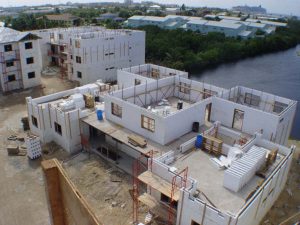
The foam that forms the ICF blocks is treated with flame retardants. While the foam may melt under extreme heat, it doesn’t ignite easily and doesn’t contribute to the spread of fire. ICF walls are, by design, seamless and airtight, so there are fewer gaps for flames or smoke to travel through. This can stop a fire from spreading to other parts of the interior.
ICF wall assemblies are recognized as meeting stringent fire resistance standards, having recently passed the when used in combination with either combustible or non-combustible exterior veneers.
“ICFs have long been recognized for their high-performance envelope and resilience to fire. The results of this study confirm code compliance and validate the application of ICFs in multi-storey construction,” Shamim Rashid-Sumar, senior vice-president, codes and standards of the National Concrete Ready Mixed Association (NRMCA).
ICF costs between more than wood framing. However, this is a somewhat simplistic comparison that overlooks several key points impacting costs both during construction and ownership after completion.
Homes and multi-storey residential or commercial buildings are insured during construction under Builder’s Risk Insurance (BRI) policies, covering damage to the structure before occupancy. After occupancy, a homeowner or commercial property insurance policy takes over.
Insurers recognize wood buildings pose a higher risk not only from fire but from other natural disasters like extreme wind events. This is reflected in the increased cost to insure a wood building versus one built with ICF.

Several years ago, even before ICF achieved its NFPA 285 test protocol accreditation, the NRMCA undertook under the auspices of Pieter VanderWerf, a Boston College professor and president of Building Works, Inc.,to investigate several issues, including the cost differences for BRI between concrete and wood frame multifamily buildings and if any insurance premium savings for concrete continue after construction.
The “reference building” used in the study was a hypothetical four-storey, 92-unit apartment building located in five different cities across the United States, each with a project value at the time of $14 million and a construction time of 15 months.
In all cases, insurance rates for concrete were significantly lower over the term of the BRI policies by a margin of 23 to 66 per cent depending on location. These savings reduce much of the ICF’s initial cost premium over wood framing, reductions that can be expected to continue after occupancy, a long-term benefit for owners.
While ICF’s fire resistance is something builders should consider, ICF has other advantages, many of which offer direct benefits when overall building costs are calculated.
For example, interior walls are smooth and ready for drywall, and since insulation is part of the ICF system, nothing needs to be added, not even vapour barriers. For owners, the exceptional thermal performance, high R-Values, and air-tight assembly means lower energy costs over time.
In conclusion, the assumption stick construction is best choice for homes or low-rise buildings simply because wood is inexpensive lacks a proper assessment of all the cost factors.
Importantly, in an era of increased fire risks, the insurance industry provides important guidance towards the most fire-resistance building materials and methods through its policy offerings. ICF and cold formed steel are excellent alternatives.
John Bleasby is a freelance writer. Send comments and Climate and Construction column ideas to editor@dailycommercialnews.com.

Recent Comments
comments for this post are closed