


Perhaps some considered 3D Printed Concrete (3DCP) a gimmick when it first arrived on construction sites in China 10 years ago and shortly afterwards in other countries.
Even though the process can trace its roots back to the early 1940s, it is only in the last few years that it has moved beyond producing small, simple structures to those of increased size and significance.
That’s because 3D printing machines have grown in scale alongside the evolution of 3D concrete mixes. 3DCP acceptance has grown to the point that even corporate giants like Walmart plan to use the technology for the construction of new facilities across the United States.
The exciting future of 3DCP is reflected in a recent Grand View Research .
“The global 3D printing construction market size was estimated at US$53.9 million in 2024 and is expected to reach US$4.18 billion by 2030, growing at a CAGR of 111.3 per cent from 2025 to 2030.”
The report goes on to say, “3D printing in construction is a vital technology in this space, enabling the rapid construction of smart infrastructure such as modular housing, advanced utility systems and adaptable public spaces. Its flexibility supports the design of customized structures that integrate IoT devices, green roofs and energy-efficient materials, all essential components of smart urban infrastructure.”
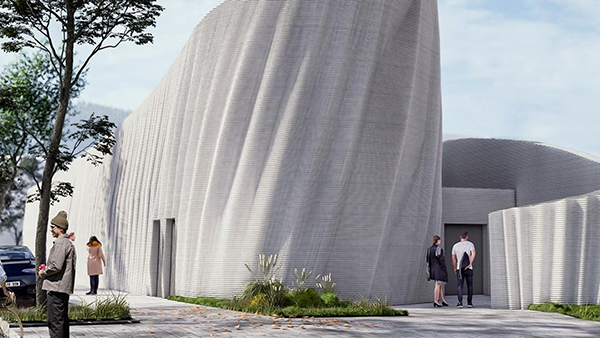
These growth estimates can only be achieved with the further development of machinery and new advanced materials.
Evident of the scale needed to produce ever-larger buildings, the printers used in 3DCP construction today are either mounted on gantries — bridge-like overhead structures that support the nozzles — or have robotic arms that reach 30 feet high.
Presently, the printer industry is dominated by a small number of players.
Danish company COBOD leads the European market with offices in the United States and Malaysia. Its 3DCP printers have also been used in Latin America, Europe, the Middle East and Africa.
COBOD’s BOD2 printer, released in 2019, has proven very popular. It consists of a gantry system, equipped with several modules based on the specific construction project. The BOD2 has a ground-mounted expandable track that quickly and easily guides the printer from one building to the next.
The company its even-larger BOD3 printer system in 2024 that operates across three-dimensional space with a modular steel design that adapts to the size of each project.
“Equipped with an extendable, ground-based track system, the BOD3 adds a new level of mobility to 3D construction, making it easier to scale up and shorten project timelines.”
The BOD3 was used to construct in 2025, a 36-unit student housing development in Denmark, with a total printed area of 1,654 m² across six buildings.
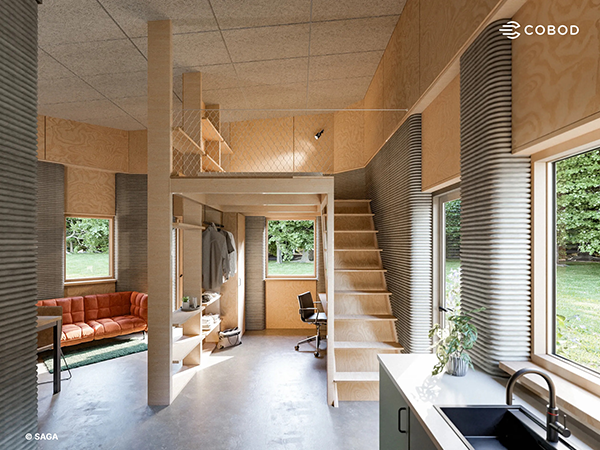
Other 3DCP companies are now appearing in Europe, the United States and the Middle East, offering an ever-wider range of sizes and capabilities to meet the expanding market demand.
In North America, perhaps the best known 3DCP printer company is ICON, based in Austin, Texas. Over the past few years, ICON’s technology has been used to construct almost 250 homes and other structures across several developments in Texas.
In March, ICON the launch of Titan, its multistorey 3D-printing robotic construction system that can create 3D printing up to nine metres in height. Rather than simply leasing or selling its Titan printer, ICON is offering a full construction platform that includes robotics, software, architecture, training and ongoing support.
3DCP construction is ideal for linear printing projects up to 10 metres in height. The technique can also be used in a hybrid fashion, consisting of printed lower levels with additional floors and gabled roofs made with engineered wood products, as proposed for the 80-home residential development near Houston, Texas.
Alongside 3D printer development has been the evolution of the concrete mixes pumped through the printer nozzles. The key here is extrudability and shape retention.
Traditional concrete can clog printer nozzles and does not adhere properly to the previous layers as they are created. Although still a cement-based mixture resembling mortar, 3D concrete mixtures can now include waste materials, plastic and recycled plastic, metal and local natural materials like sand and clay.
Many of these concrete mixes are proprietary and patented blends optimized for specific 3D printer makers. For example, ICON introduced CarbonX in 2024, which the company has a carbon footprint 42 per cent lower than previous materials.
Other blends are openly available to the market through the world’s leading concrete manufacturers like international Danish producer Aalborg Portland Holding. It has introduced FUTURECEM, which they replaces clinker with a “unique synergy between limestone and calcined clay.”
Mexican-based Cemex and COBOD have addressed the higher costs often associated with the custom blends. In 2021, they introduced a 3D printing solution called D.fab. This mix utilizes 99 per cent conventional concrete and only one per cent of the so-called proprietary “Magic Mix” additives and is compatible with other 3D printers.
“Current 3D printing methods rely on highly specialized and expensive mortars,” Cemex .
The company says D.fab, “transforms conventional concrete into a versatile material that can be efficiently tailored for 3D printing construction. This admixtures innovation produces a more fluid and malleable concrete that facilitates the pouring process for 3D printing applications.”
First introduced in Angola, D.fab has since been used successfully in Mexico, Japan, Malaysia, Europe and the United States.
The future of 3DCP construction faces challenges such as high initial investment costs, building code acceptance and certain height limitations. Those seeking work with 3DCP processes also need high levels of training and education. However, the promise of lower embodied carbon, improved efficiency and productivity is compelling.
John Bleasby is a freelance writer. Send comments and Inside Innovation column ideas to editor@dailycommercialnews.com.




Recent Comments
comments for this post are closed