

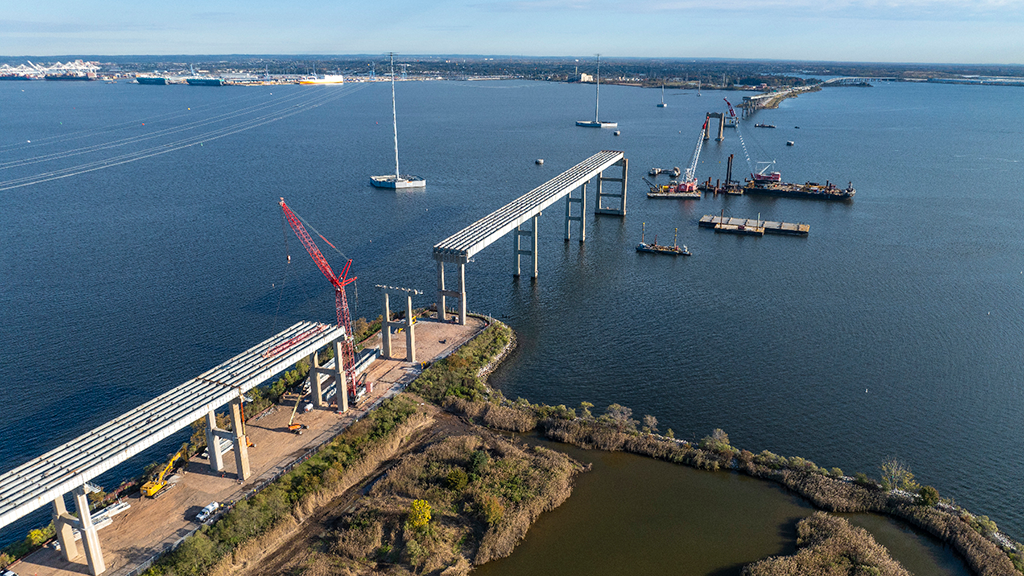
Nearly two years after the catastrophic collapse of in Baltimore, a long-awaited and very costly rebuild of the lengthy span has moved into the construction phase.
The skyline over the Patapsco River is now punctuated by cranes, steel piles and the unmistakable signs of a megaproject taking shape. Demolition of the existing bridge and a comprehensive test pile program are underway to validate soil conditions beneath the riverbed.
However, what began as an urgent plan to restore a severed transportation artery has evolved into one of the most expensive and closely watched infrastructure rebuilds in the U.S.
The price tag for the project has surged to $5.2 billion, more than triple the initial estimate. When the original structure collapsed on March 26, 2024, after being struck by a malfunctioning container ship, the replacement was pencilled in at $1.7 billion, with traffic restored by late 2028.
By November 2025, however, the Maryland Transportation Authority (MDTA) revised its estimate upward to a range of $4.3 billion to $5.2 billion and pushed the anticipated opening to late 2030.
Officials cite several major reasons for the hike: rising global prices for steel and concrete, expanded federal safety mandates, updated geotechnical data gathered during pre-construction and the decision to incorporate a robust vessel collision protection system around the piers.
“As design has advanced and pre-construction work progresses, it became clear that material costs for all aspects of the project have increased drastically since the preliminary estimates were prepared less than two weeks after the initial tragedy,” acting transportation secretary and MDTA chair Samantha Biddle explained in a statement.
“The updated cost range and schedule are directly correlated to increased material costs and to a robust pier protection system designed to protect the new Key Bridge.”
The new design also increases the main span length, providing 230 feet of vertical clearance over the shipping channel.
The replacement span will be Maryland’s first highway cable-stayed bridge. It will feature twin pylons rising more than 600 feet above the Patapsco, supporting a main span exceeding 1,600 feet – significantly wider than the original.
Each direction will carry two 12-foot travel lanes, along with a 10-foot outside shoulder and four-foot inside shoulder, separated by a concrete median. The bridge will stretch 11,015 feet, with more than half requiring marine construction. The structure will include nearly 98,000 square yards of concrete deck.
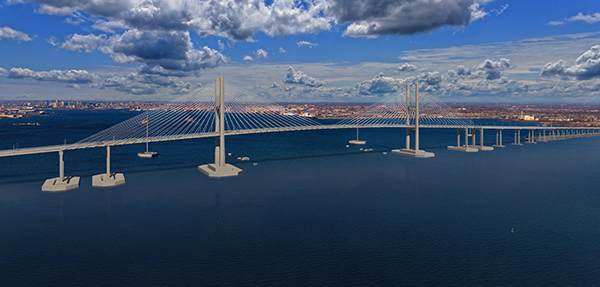
Cable-stayed bridges are widely considered the most economical solution for spans of this length, offering efficiency compared with suspension designs. But even so, the scale of the project – and the need to build over water – presents formidable engineering and financial challenges.
With half the span built over the Patapsco, the project adds a new wrinkle to scheduling, material delivery and safety oversight.
To reduce underwater noise during pile driving, crews are deploying air bubble curtains – systems that release compressed air around the piles to dampen sound waves and protect aquatic life.
The bridge piers will be protected by a collision-protection system built to the latest American Association of State Highway and Transportation Officials specifications. Structures will be built to shield the primary supports from vessel strikes, like the one that caused the damage.
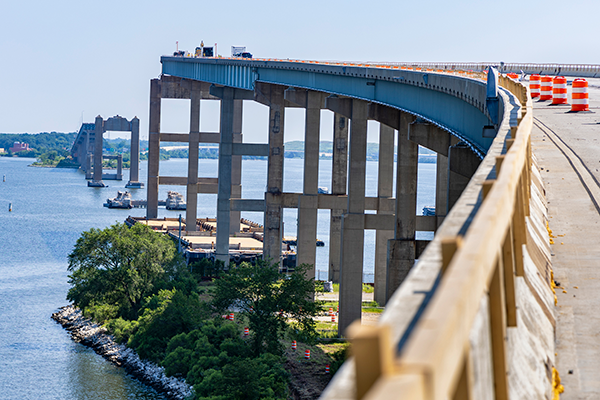
The project also includes the construction of two temporary trestle structures. One will extend from Hawkins Point on the south side, and the other from Sollers Point to the north. These over-water platforms will provide access for cranes, pile-driving equipment and material transport, reducing reliance on marine vessels and minimizing disturbance to sensitive shoreline habitats.
Such trestles are common on major marine bridge projects and help lower construction risk while improving worker safety and efficiency.
In December and January, contractors made measurable progress on the test pile program. Crews drove massive steel piles – some extending more than 200 feet – into the river floor to ensure they can support the weight and forces of the future superstructure. The piles were lifted into position using a crane and tripping barge, then driven into the riverbed with a hydraulic hammer.
Engineers also installed a load frame and hydraulic jacking system to simulate the forces the piles will experience once the bridge towers and deck are in place. Load tests were successful, confirming the strength and performance of the foundation design. Identical testing is scheduled at the northern main span pier.
Crews have removed all steel girder spans on both the north and south sides of the old bridge structure and demolished the land-side concrete columns using extended-boom excavators equipped with mechanical demolition hammers.
In spite of the forward momentum, substantial work remains.
Under the current schedule, pre-construction activities and demolition are scheduled to continue through the winter. Superstructure construction will follow, with the bridge expected to open to traffic in late 2030.
The original span carried roughly 11 million vehicles annually and served as a critical link for commuters and freight moving to and from the Port of Baltimore. Loss of the bridge has disrupted regional supply chains and resulted in truck drivers having to take costly detours.




Recent Comments
comments for this post are closed