

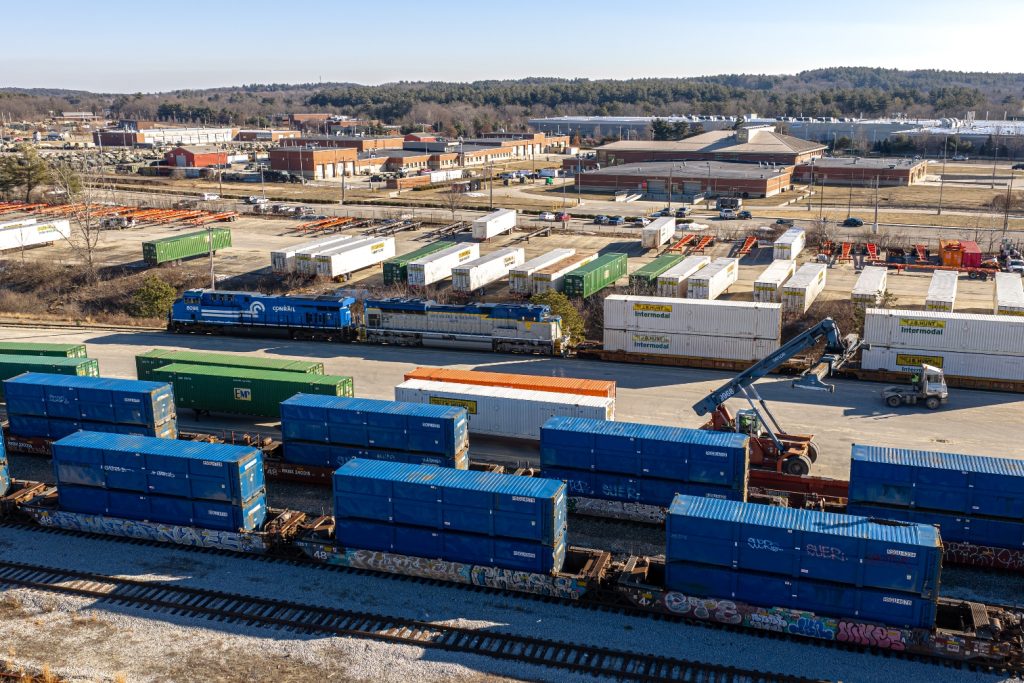
The U.S. northeast now has the edge – East Edge that is.
The goal by Norfolk Southern (NS), America’s number two Class 1 railway (after Canadian Pacific-Kansas City) by revenue and routes, is not metaphorically only to give shippers faster freight movements between the Boston area and Chicago.
It literally describes the geography of one of the last major freight corridors to get such an overhaul.
“East Edge reflects both the eastern reach of our intermodal network and the operational edge this service creates by opening a fully double-stack corridor into New England,” NS spokeswoman Katelyn Byrd said.
Despite the significance of both cities to commerce, shipping capacity had always been constrained by the fact the railway – and its predecessors – couldn’t operate double-stacked freight trains.
The demand has now especially increased due to e-commerce and expanding distribution hubs, forcing many shippers to increasingly use trucks.
As of Jan. 11, all that has changed. Now, seven days a week, one 9,000 foot double-stacked train operates in each direction.
“That unlocks capacity and resilience in a region where demand has outpaced rail options for years,” Byrd said.
The $64 million P3 completes three years of hard infrastructure upgrades and figuratively 40 years in transforming NS into a full intermodal network, with double-stacks carrying containers or truck vans.
Specifically, the route connects the city of Chicago on the west to Ayer, Mass., New England’s primary intermodal hub, just outside Boston’s I-495 ring on the east.
Why 40 years?
Complex challenges. The line crosses several states and government jurisdictions. The work had to have the co-operation of several other railroads and simply the process of addressing legacy infrastructure incrementally.
“Achieving full clearance required years of co-ordination, long-term agreements and highly technical engineering work,” Byrd said. “You address one constraint at a time, over many years, until the entire corridor finally comes together.”
In fact, hardly all the route was transformed but essentially a series of choke points where bridges and tunnels had to be expanded, some track rebuilt and new signaling installed.
“In railroading, you can have hundreds of miles of track that are ready to go, but a handful of pinch points can limit the entire route,” Byrd said. “Solving those constrained locations required custom engineering solutions and close co-ordination with public agencies and partners.”
The most crucial overhauls were in the corridors between Delanson and Voorheesville, N.Y – southwest of Albany – and between Worcester and Ayer, Mass.
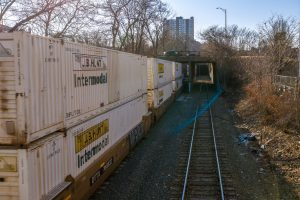
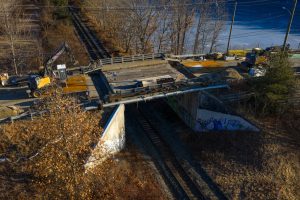
In the first, 15 miles of limited used dual tracks were replaced, 13,600 crossties installed and 14 crossings upgraded. Meanwhile in Massachusetts, three bridges were raised 12 to 18 inches and two legacy tunnels had the floor lowered with stone track ballast replaced with a concrete base.
“Rather than raising the tunnel, crews lowered and re-engineered the track structure to create the necessary clearance, while maintaining safety and structural integrity,” Byrd said. “It’s a good example of the kind of precision engineering required on this project.”
While one of the last NS corridors to create double-stack “clearance,” it’s not the final one. That’s taking place in western Pennsylvania with completion set for 2028.







Recent Comments
comments for this post are closed