

A report soon to be published by the Canada Green Building Council (CAGBC) has found the green building industry supports more than 500,000 Canadian jobs, including 178,000 in construction and the sector contributes $80 billion to the GDP.
Titled Building Prosperity, the report “quantifies the economic impact of green building,â€� Laurna Strikwerda, project development and research with CAGBC, told an audience at the Green Building ÈȵãºÚÁÏ Summit held in downtown Toronto recently. Â
“We really continue to see a lot of value from decarbonization.�
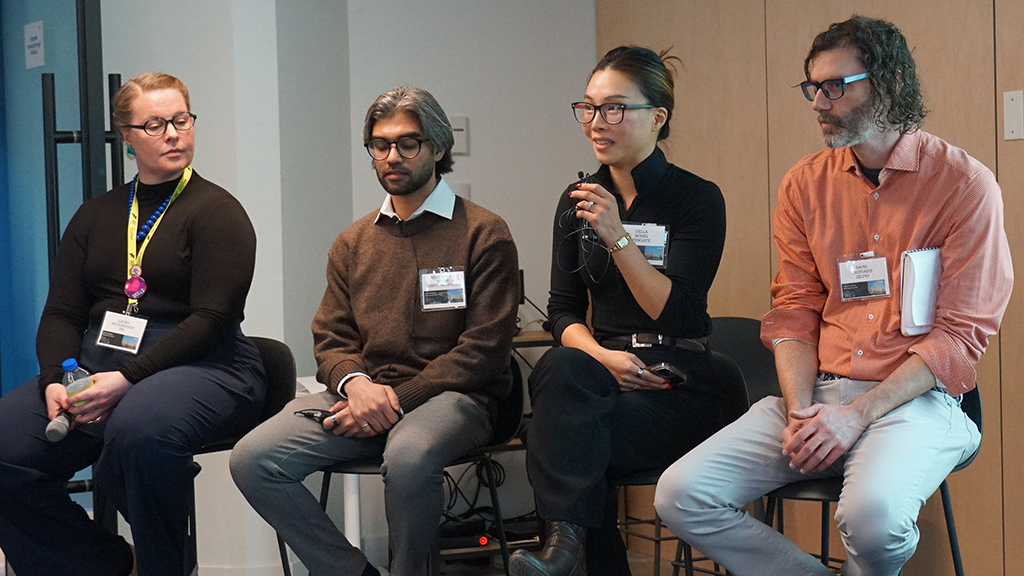
Strikwerda, who moderated a panel seminar on workforce development recently at the half-day-long summit, says the report is based on 2024 data and will be published at the end of March.
While construction and trades are the largest contributor to jobs in the green sector, others are materials and manufacturing companies, professional services, utilities, waste recycling and policy and education, said panellist David Photiadis, the lead researcher on the report and senior director of The Delphi Group.
The commercial sector has made substantial progress but Canada still has roughly half-a-million older, inefficient buildings needing deep retrofits and every new project would have to meet high‑performance green standards for Canada to meet its 2030 and 2050 net‑zero goals, says Photiadis.
Canada’s bigger challenge, however, lies with the residential sector where about one million buildings need to be retrofitted.
“There is no chance to get to net-zero without deeply focussing on residential.�
He says the report’s data indicates a quarter of the GDP contribution was from decarbonization efforts, “$20 billion in 2024.�
Potential job growth is significant if policy-makers, building owners and others make decisions based on green development, he says.
While the decarbonization sector isn’t facing labour shortages, as it scales up needs for electricians, technicians, control specialists, retrofit teams, commission professionals and building operators will grow, Photiadis says.
Strikwerda says the CAGBC wants to see training and education tightly aligned with real industry demand paired with greater harmonization of standards so the sector has a clear pathway to delivering green buildings.
“We believe Canada has the tools, technology and market momentum and what’s needed now is scale and co-ordination.�
Panellist Laura McDonough, associate director of knowledge mobilization and insights, Future Skills Centre (FSC), which funded the CAGBC report, says a diversified workforce is paramount to green sector growth.
Training is one challenge, retaining underrepresented groups is another, which involves changes to workplace culture, she says.
“The projects successful in increasing that representation are the ones willing to do the hard work to make their workplace culture more accepting of those groups.�
Panellist Della Wang, director, responsible investment, Fengate, says a core workforce challenge is getting passed the stigma attached to construction work, a problem made worse by a culture on jobsites that is unwelcoming to underrepresented groups.
She adds establishing apprenticeship training is essential.
“If you are an asset manager, putting in a mandated apprenticeship of five to 10 per cent just helps people to understand there are green and sustainability opportunities.�
Mohammad Haque, sustainability manager, Mattamy Homes, says a protracted lull in residential construction will discourage many young people from entering the trades and building professions. Â Â
Mattamy’s answer to drawing and then retaining young people to the company focuses on offering a wide scope of different types of jobs and professions in the field of sustainability.Â
He adds the company has crafted sustainability principles into job descriptions across every department, even in areas that traditionally are not connected to environmental performance, such as customer care and sales.
“Now when I go to my sales team they know exactly what is happening with a geothermal system in our buildings.�
Haque says partnering with the “right people� in sustainability fields helps Mattamy staff develop core green standards useful in future projects. For example, applying low-carbon strategies learned from one project through an architect to future projects.
Wang says to meet 2030 net-zero goals, companies have to start making long-term supply chain planning, especially because of the economic uncertainties.
“We won’t have the time in 2028-29 when your equipment is scheduled to be in place.�
Haque adds now is the time to revamp the way trades are trained.
“There is so much innovation happening in construction right now that is not captured in training.�




Recent Comments
comments for this post are closed