


Like so many buildings of the early 20th century left abandoned, the 3,300-seat New Victoria performance hall in Bradford in West Yorkshire, U.K., could have been demolished. Its spectacular interior architecture, featuring soaring vaulted ceilings, would have been forgotten. Instead, it has been saved and restored to its former glory.
New Victoria opened in 1928 as the biggest theatre outside London and the U.K.’s first to be purpose-built for screening “talkies.”
Over its life, the venue became known as The Gaumont and used as a ballet and concert venue, complete with an orchestra pit and Wurlitzer organ.
Legendary performers took to the Gaumont stage, like Buddy Holly in 1959 and The Beatles in 1963, along with several appearances by The Rolling Stones between 1963 and 1965. In 1968, the interior of the building was split up to form a bingo hall and two small cinemas, and was renamed the Bradford Odeon. In the process, many Art Deco finishes were lost. The doors finally closed in 2000 and the building left empty.
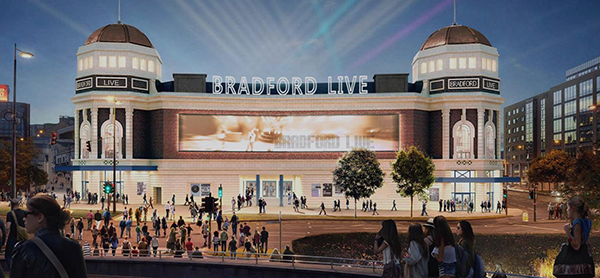
Several concepts were discussed concerning the abandoned building and its site. Most brutal was a plan in 2002 to simply demolish everything. To this end, an architectural contest in 2006 resulted in a £55 million plan for a 100-room hotel, 205 apartments, offices and leisure and retail space, and a new public square, all of which were to be completed by 2009.
This plan was scrapped after considerable public outcry.
In 2014, Bradford Council acquired the empty venue for £1, and opened a competition for developers to submit commercially viable ideas for the building. Council approved a plan proposed by the locally-led, not-for-profit distribution social enterprise called Bradford Live.
The group would fully refurbish the building to the latest standards and restore it as a modern, flexible multipurpose venue with a 3,800 capacity that would host live music, entertainment, conferencing, weddings and banquets.
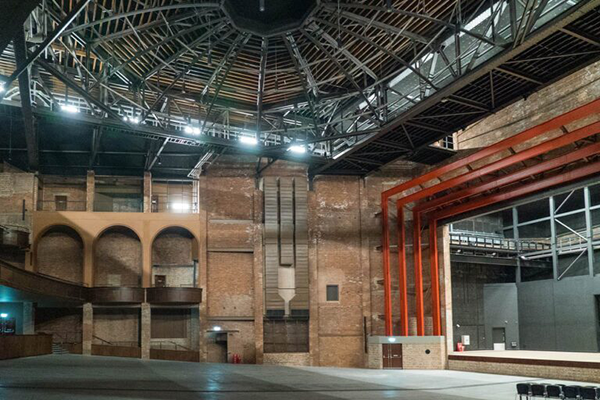
In 2019, work began under the of London-based Tim Ronalds Architects, a firm experienced in historic restorations. Demolition of the old cinema interior structures allowed the size and scale of the original auditorium to be revealed for the first time in 50 years. Practical completion was certified in 2024.
The £50 million project was complex in almost every respect. Consulting civil and structural engineers Price & Myers extensive investigations of the existing structural fabric were required, including the steel, brick, concrete and masonry, along with load testing of the existing floors. Years of neglect, roof leaks and the implications of the 1960s bingo hall alterations needed to be understood as well.
“Bradford Live was full of surprises,” Price & Myers associate engineer, Gemma C. “No two corners were the same and each required its own unique detail. It’s not often you get a project like this.”
Mechanical and electrical engineers Buro Happold the venue also presented significant MEP challenges. For example, there were only two existing mechanical plant rooms in the basement supporting a minimal amount of MEP, such as the single fan that provided most of the building’s ventilation.
“Rather than fighting against the constraints presented to us, we evolved our MEP design around them,” they said.

New air handling units, boilers and electrical systems were fitted within this restricted area and routed throughout the building with minimal disruption to the style of the Victorian design.
The MEP equipment was located to best suit both the available area and the varied use of spaces throughout the building. Services were concealed in some areas like the cabaret bar and the ballroom.
In the foyers, services were left exposed for a more industrial feel. Within the auditorium itself, refurbished existing duct routes accommodating Buro Happold’s air distribution solution were left to complement the stripped-back esthetic that celebrates both the original brickwork and new steel structure elements.
As a part of the mission to be locally funded and supported, main project contractor RN Wooler & Co created apprenticeship roles for five 16 to 18-year-old students among the 65 workers employed during the construction phase. The company also focussed on of local suppliers and subcontractors.
The restored venue hosted its first live concert at the end of August this year. It is expected to attract up 300,000 visitors annually to the city and not only support those employed directly but also up to 500 fulltime-equivalent jobs in the area.
Bradford Live has a future calendar of more than 200 world class music, comedy and family entertainment events. It will also provide the city with first-class conference, meeting and banqueting spaces.
“Our vision is to promote Bradford as a cultural hub for the region, celebrating the city and venue heritage while ensuring world-class event spaces for generations to come.
“Historic features and contemporary interventions stand side-by-side as testimony to the building’s varied and often brutal past, and a reminder that Bradford Live is a venue that has shaped the city’s past, present and future,” says Buro Happold.
John Bleasby is a freelance writer. Send comments and Climate and Construction column ideas to editor@dailycommercialnews.com.




Recent Comments
comments for this post are closed