


The search for better building materials continues, with suppliers and engineers exploring new methods, materials and design tools to minimize cost, carbon and manpower while maximizing speed.
But amidst that eternal quest for innovation, says Craig Slama, an engineer and partner with Jablonsky, Ast and Partners, many of Canada’s most iconic projects in the past relied on one simple, essential building material – reinforced concrete.
Slama told delegates attending a recent session at the Canadian Concrete Expo in Toronto it’s certain as Canada enters a new era of major projects, reinforced concrete will continue to be primary among all materials.
“You can do anything with concrete,” said Slama during his presentation, billed as .
“There’s no other construction material that can do what reinforced concrete can do. There’s other materials, and there’s a place for other materials, but the bulk of anything we build in Canada in the foreseeable future will be reinforced concrete,” he added during an interview after the session.
Slama said innovations such as 3D‑printed concrete, modular construction, green concrete, glass‑fibre‑reinforced polymer and AI-assisted design demonstrate the potential for faster, more efficient and sustainable construction. Each approach offers unique advantages, from rapid onsite assembly to reduced environmental impact.
Yet reinforced concrete remains a versatile, durable, fire-resistant material, allowing virtually unlimited architectural expression, Slama said.
“You can’t build highways or dams out of wood,” he said.
Even the George Washington Bridge in New York City, a renowned steel suspension structure, requires constant painting, he argued
“The maintenance cost on a steel bridge is phenomenal,” Slama said.
He acknowledged a reinforced concrete project like Toronto’s Gardiner Expressway is now requiring significant upgrades but, he said, that is because it was neglected for too long.
Slama offered insights into five iconic Canadian structures created with reinforced concrete:
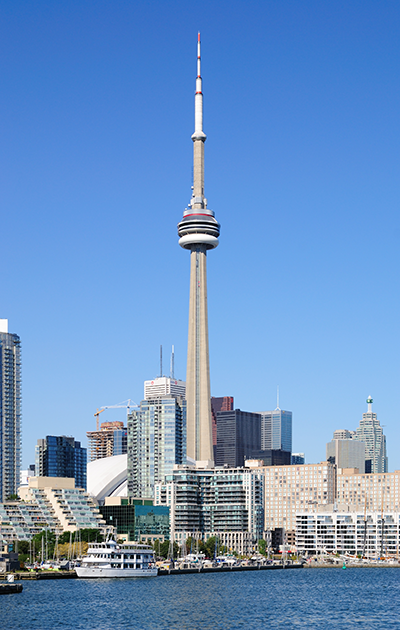
CN Tower
Completed in 1976, Toronto’s 553-metre CN Tower required 450,000 cubic metres of concrete, 4,500 tonnes of reinforcing steel and 1,050 tonnes of post-tensioned cable. Commissioned by Canadian National Railway, built by the Foundation Company of Canada and Aecon as general contractors, with Roger Nicolette and Associates serving as the structural engineer of record, it employed 1,500 workers over three years. It was the world’s tallest free-standing structure from 1975 to 2007.
Why it’s Innovative – Wind-tunnel tests refined stability; dampers reduced sway; post-tensioning strengthened concrete; slip-forming enabled continuous vertical pouring; helicopters lifted and installed upper structural sections efficiently and safely.
Confederation Bridge
Completed in 1997, the 12.9-kilometre Confederation Bridge connects Prince Edward Island with mainland Canada across the Northumberland Strait. Built with structural engineering by J. Muller International and Stantec, it used 440,000 cubic metres of concrete, 55,000 tonnes of reinforcing steel and 20,000 tonnes of post-tensioned cable.
Why it’s Innovative — Ice shields are constructed of high-strength, air-entrained 93-megapascal concrete with 100-millimetre cover, using mix designs engineered to resist up to 500 freeze-thaw cycles and severe abrasion. Tiny air bubbles are mixed into the concrete to allow the concrete to expand and contract, reducing cracking.
Habitat 67
Habitat 67, designed by architect Moshe Safdie, was built for Expo 67 in Montreal as an experiment in modular urban housing. Conceived as a new model for high-density living with suburban qualities, it showcased prestressed and precast concrete assembled using industrial methods. The project became an influential example of modernist public housing and modular construction.
Why it’s Innovative — Cross-disciplinary collaboration, fully prefabricated modules, post-tensioned precast supports and experimental massing studies using LEGO blocks during design development.
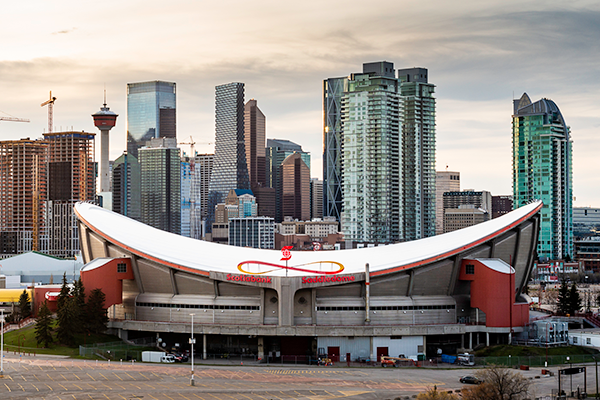
Calgary Saddledome
Owned by the City of Calgary, the Calgary Saddledome was designed by Gimprich, Koski, Riley Architects. Construction took place from 1981 to 1983, employing thousands of workers. It cost $100 million, and remains one of Canada’s most recognizable buildings, hosting the Calgary Flames’ Stanley Cup win in 1989.
Why it’s Innovative — Construction of the arena used almost exclusively precast components, with low-density concrete of 1,500 kilograms per cubic metre compared with the typical 2,400, at 30 megapascals strength. This reduced material volume by 50 per cent and enabled unobstructed sightlines throughout the stadium.
Hibernia Platform
Completed in 1997, it’s an offshore oil platform in the North Atlantic off Newfoundland. Built by Kiewit Kvaerner with structural engineering by numerous firms, it stands 260 metres tall, including an 85-metre caisson and 140-metre topsides. Construction required 165,000 cubic metres of concrete, 95,000 metric tonnes of reinforcing steel and 7,500 metric tonnes of post-tensioned cable. It employed 6,000 people during construction and has produced over 1.5 billion barrels of oil.
Why it’s Innovative — The platform uses over 400,000 tons of ballast, three-level slip-form construction, integrated water, air and power systems, iceberg detection and avoidance, and extensive vertical and horizontal reinforcement to resist extreme North Atlantic conditions.

Recent Comments
comments for this post are closed