


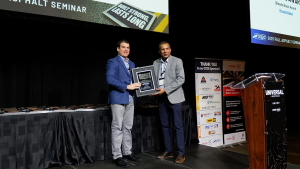
While asphalt technology has and will continue to change, the best practices to produce durable and quality mixes remain constant, the keynote speaker told attendees at the Ontario Asphalt Pavement Council’s recent fall seminar.
The objective is to achieve those best practices, said Gencor Industries senior vice-president Dennis Hunt.
“There are things that we do good, things that are better, and things that are best. How do we achieve best practices?”
Rather than doing a deep dive into the technical details of managing asphalt plants, Hunt focused on common sense best practices he has acquired and observed as a third-generation asphalt industry member.
Based in Orlando, Fla., Gencor is a manufacturer of asphalt plants, soil remediation plants, combustion systems and heat transfer systems for the road and highway construction industry.
His family’s entry into the business began when his accountant grandfather purchased an asphalt plant on Dec. 6, 1941.
That was the day before the attack on Pearl Harbour. Hunt drew heavily on that family history and his personal experiences visiting the plant as a young boy and later working there.

He described best practices as non-compulsory control measures that incorporate cleaner production, waste minimization, plus recycling and reuse initiatives. Best operating practices include being aware, vigilant, observant and being a good neighbour to the surrounding community.
Another key element is an emphasis on employee training, with particular attention on the need to review and know permit conditions and limitations as well as reviewing safety data sheets.
“I don’t think you can plan too much.”
But he added a caveat.
“You need to be careful about who is doing the training,” said Hunt, recalling an incident during one of his boyhood tours of the family plant in which the employee conducting the tour provided some wrong advice on an operating technique.
Besides constantly reviewing safety procedures and obtaining all the required permits, good planning also encompasses a continuous observation and inspection of equipment.
Included in that list are asphalt plant stacks, vents or chimneys that exhaust gases from the aggregate drying and heating processes.
“Check that stack. If dust is coming out of it, it’s time to do something about it.”
Another critical piece of equipment is the burner, which provides the intense heat to dry and heat aggregates in a rotating drum. Describing the device as “the heart of the plant,” Hunt said proper storage/handling of aggregates and tracking fuel consumption are some methods to ensure its performance.
Keeping up-to-date maintenance records is also crucial and that applies to both large pieces of equipment and small components, such as bearings.
A bearing with a five-year useable life span that has been in place for four years will need replacing at some point, he said.
Another best practice is simply to walk through the plant looking for potential trouble areas. But the direction of those walks should be periodically changed to provide a different perspective.
“Change your routine. As I walk through a plant I take a different route.”
The speaker also strongly urged the audience to write down their company goals to ensure those goals are acted on.
“A goal not written down is nothing but a wish. We know what happens to wishes. Never be satisfied with the way things are.
“They (plant operators) should always be looking beyond their normal routine for the endless opportunities of increasing production and decreasing operating costs.”
In wrapping up his talk, Hunt recalled his father’s favourite statement about what the asphalt industry should be striving for in building highways: “Highways should be ribbons of velvet smoothness.”


Recent Comments
comments for this post are closed