


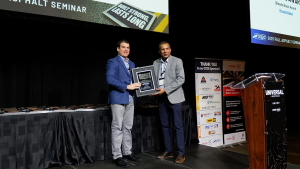
In opening the Ontario Asphalt Pavement Council fall seminar, chair Chris Campbell described the event as a “collective journey” to think about how the industry operates, produces and uses asphalt.
And that was certainly the underlying message of the day-long program, whose theme was Build Strong, Lasts Long.
Held in a Vaughan banquet fall, the event featured a number of speakers who shone a spotlight on a range of technical, research, equipment and installation advancements and improvements in the industry.
Leading off those speakers was the National Center for Asphalt Technology’s (NCAT) associate research professor Fan Yin.
In a presentation titled How Much Does Compaction Play Into Durability, Yin provided an overview of a joint Florida Department of Transportation and NCAT study on in-place asphalt density and its effects on pavement performance.
In 2018, four different test sections with different asphalt densities were installed on the NCAT Pavement Test Track, a research test facility at Auburn University in Lee County, Alabama. Those sections were then subject to a series of weekly field tests to evaluate rutting, roughness, surface texture and cracking. Those sections are still performing well, said Yin.
The audience also heard from Gelu Vasiliu, the head of the Ministry of Transportation’s bituminous section. A regular guest at the fall seminars, he reviewed the testing parameters and tools used to validate collected data in mix performance testing.
Later in the day there was a specific session devoted to innovative technologies. It featured three different speakers, one of whom was Jenna Bowers, the recycling and stabilization manager for Charleston South Carolina-based Ingevity.
The first part of her address was concentrated on the environmental and economic advantages of using warm mix asphalt. Produced at lower temperatures than hot mix asphalt, the benefits include reduced emissions and fuel use, less oxidation and improved binder quality.
Bowers presented the conclusions of a demonstration project in Utah where three different types of asphalt mixtures were used: Standard hot mix asphalt produced at 160 C; hot mix asphalt incorporating hydrated lime manufactured at 165 C; and warm mix asphalt produced at a much lower 127 C temperature.
One of the major findings was that the lower production temperatures “did not negatively affect rutting resistance.”
Bowers also emphasized the sustainability reasons for incorporating cost-effective Reclaimed Asphalt Pavement (RAP) into projects wherever possible. The demand for RAP is increasing and enhancing its use is the availability of rejuvenators, which are special additives for restoring aged, stiff asphalt binder from old pavement.
A 2024 rejuvenator demonstration using high mix RAP amounts at the NCAT Pavement Test Track yielded positive results, she said.
“Field performance has been good after one year of traffic tests.”
Tackling the challenging problem of reflective cracking on overlays on thick asphalt and concrete pavements was the topic of the segment’s second speaker, Surface Tech’s technical director Michael Simons.
Surface Tech is the developer of ARMI (Aramid Reinforced Mix Interlayer), a specialized and flexible one-inch-thick asphalt layer infused with aramid fibers, designed to prevent cracking on overlays on thick asphalt and concrete pavements.
Using two road construction projects, one of which was in Ontario and the second in New Brunswick, Simons provided a summary of its successful application.
Conducted in 2024, the installation of a two-lane, 6.6-kilometre-long overlay transformed a deteriorating 38-year-old concrete surface of New Brunswick’s Highway 8 into a “long lasting cost-effective roadway.”
By reducing the need to remove and recycle the existing concrete, the project conserved both raw materials and energy and reduced the emissions associated with asphalt production, he said.
It also avoided a costly and lengthy shutdown of the highway which leads to New Brunswick’s popular Miramichi River tourist region, said Simons.
The second overlay installation occurred on a trial 700-metre section of a single outside lane on Highway 401 near Nappanee. Paving began in 2024 and carried on into the first part of 2025.
It’s not uncommon for an asphalt overlay on concrete to crack after the first winter. But that hasn’t happened in either of these projects, said Simons.
The best practices for installing trackless tack coating and why it should be used in projects was the focus of the third speaker, McAsphalt Industries Limited’s innovation and product development director Tony Kucharek.
A non-tracking tack coat, a specially formulated asphalt emulsion that provides strong bonding between different pavement layers, but dries quickly was used.
Working with non-tracking tack coats requires the same precautions and best practices as with other asphalt applications, said Kucharek.



Recent Comments
comments for this post are closed