

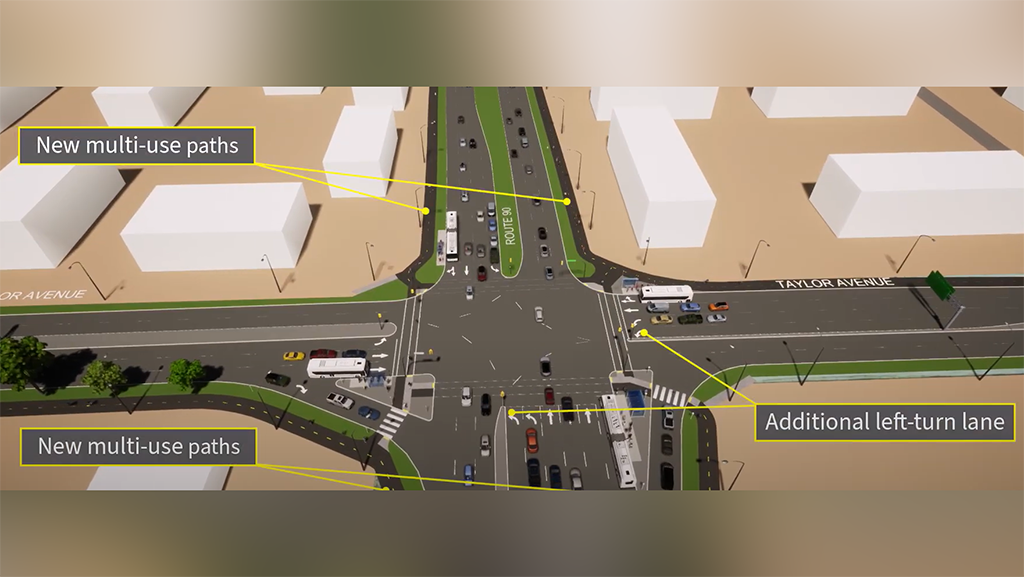
Winnipeg is starting to move forward with the long-delayed , which calls for expanding Kenaston Boulevard and replacing the St. James Bridge in the west end of the city.
City council voted recently to approve $5 million in its 2026 budget to begin acquiring more than 100 properties in a first step toward widening Kenaston.
The boulevard is a section of Route 90, a major north-south artery in southwestern Winnipeg that is used by thousands of motorists every day and leads to the St. James Bridge.
Built in 1962, the two spans that comprise the bridge carry roughly 78,000 vehicles per day over the Assiniboine River, making it one of the busiest bridges in River City.
Plans call for widening Route 90 to six lanes between Taylor Avenue and Ness Avenues, a distance of about six kilometres, replacing the aging St. James Bridge, and overhauling underground sewers and land drainage.
Mayor Scott Gillingham made widening Kenaston one of his major campaign promises in the 2022 civic election.
The city says the Kenaston-St. James Bridge project would provide long-term benefits by improving traffic flow, accommodating future development and replacing critical infrastructure before it fails.
A recommended project schedule has construction starting in 2028 and completing before 2033, assuming council approves the project in 2026.
The current estimate for the project is $613.9 million, plus an additional $143.4 million in construction-period interest.
Although the preliminary design was approved by council in 2024, the project has not yet been fully funded.
The city expects to have discussions with the Manitoba and federal governments about sharing the cost.
Deloitte LLP was hired to review delivery models and conduct a value-for-money analysis. The firm initially considered, but ultimately ruled out, delivery methods that bundled into a single contract the several major components of the project.
“This is because the key parts each have unique challenges, attract different types of construction companies, and carry different risks, making a single ‘bundled’ approach less effective than taking an approach that is more tailored to the unique aspects of each component.”
Deloitte recommends a traditional design-bid-build approach, broken down into several contracts for specific components.
“This strategy aims to leverage competition, manage known risks effectively, and align with the capabilities of the construction market.”
Like many cities in Canada, Winnipeg has more infrastructure needs than the money to pay for all of them.
As a result, there is a multiplicity of opinions on which projects are most important, and which, therefore, deserve to go to the head of the funding and procurement line.
Chris Lorenc, president and CEO of the Manitoba Heavy Construction Association, supports the project.
Lorenc says city council’s Strategic Priorities Action Plan and the Transportation Master Plan have already identified the project as a strategic priority.
He also says the federal and provincial governments need to help out with funding because they’ll benefit from the economic activity generated by an improved Route 90.
He called for Manitoba and Ottawa to each contribute 40 per cent of the project’s costs.
Coun. Brian Mayes says he agrees with replacing the bridges, but the widening of Kenaston is too much to spend for not enough benefit.
“Although one of the justifications for widening the road is environmental, that is not so,” says Mayes. “Widening Kenaston will save very little commuting time.”
He says expanding St. Mary’s Road, which runs through his ward, deserves more attention than it has been getting.
St. Mary’s is a regional arterial route that is busy and getting busier, whose traffic has already exceeded the projected volume for Kenaston that is being cited to justify that project.
The city pushed back widening St. Mary’s from 2021 until 2050.
Ahmed Shalaby, professor of civil engineering at the University of Manitoba, says the bridges on the Assiniboine river are aging rapidly and need merge lanes, and land development along the route requires additional sewer capacity.
“The one element that has been controversial is the road widening and whether a wider road will reduce traffic congestion and delays or attract more traffic and cause more delays due to induced demand,” says Shalaby. “While upgrading the road network will help to some extent, it is also important to increase the utilization of transit buses and accelerate the construction of the rapid transit network as a more effective tool to address traffic congestion and greenhouse gas emissions.”
To watch a video of the Kenaston project





Recent Comments
comments for this post are closed