


Researchers at opposite ends of the earth have developed new materials that use dirt in combination with other common waste materials to take the place of those with poor recycling possibilities and high embodied carbon.
Professor Pierre Blanchet and postdoctoral fellow Simon Pépin, from the Department of Wood and Forest Sciences at Université Laval in Québec City, combined earth and wood fibres to create wall panels that could replace commonly used gypsum panels.
It’s hard to imagine that anything could take the place of gypsum plasterboards for interior construction. To begin with, gypsum boards are inexpensive, can be cut onsite and are easily fastened to an underlying framework. They are also highly fire resistant and therefore form a key component of fire safety in building design by delaying heat transfer and thus protecting the structural beams they encapsulate.
Approximately 75 per cent of Canadian gypsum production comes from Nova Scotia, with some also from Ontario, Manitoba and B.C., to the Canadian Encyclopedia. Wallboard manufacturers are located in these provinces as well as in Québec, Newfoundland, New Brunswick and Alberta.
The problem with gypsum wallboards surrounds reuse and recycling. Most discarded boards end up in landfills, although recent landfill restrictions have resulted in specific conditions that increase dumping costs. A small amount of gypsum is recycled into products such as fertilizer, concrete and specialized ceramic blocks.
The earth-wood fibre boards created at Université Laval seek to resolve these issues.
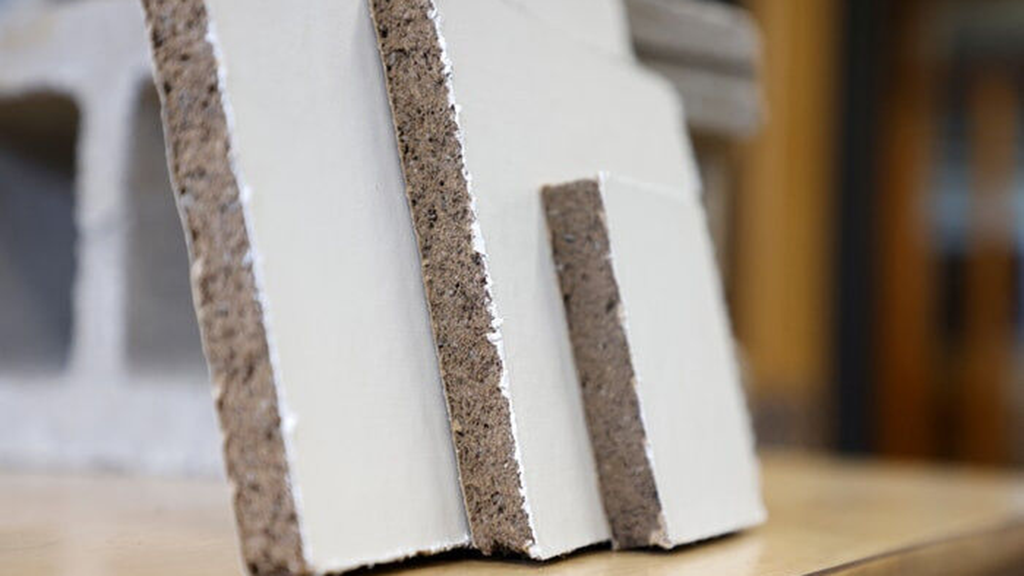
In a detailing their research, Blanchet and Pépin used soil extracted directly from the Université Laval campus and passed it through a three millimetre sieve. This was mixed with MDF wood fibres from a variety of species obtained from Uniboard, also in Laval.
The soil and wood fibre mix was then dried at 103°C for 24 hours before weighting. Gypsum lining paper, laser cut and folded over all the faces of the boards, was glued to the earth-wood fibre blend with a diluted type 3 PVA glue.
The finished boards in the study were tested in comparison with a commercially-available control wallboard. The researchers chose a 16-millimetre-thick light type X control gypsum wallboard manufactured by Cabot Gypsum due to its low thermal transmission and flame spread rating of 5.
The results were very promising. The test boards displayed improved acoustic properties along with mechanical and thermal properties very similar to those of the control gypsum boards. It was shown, however, that the earth-wood fibre wallboards had a reduced Modulus of Rupture (MOR) — flexural strength or bend strength — indicating they would break more easily during handling, installation or under load than the control boards.
Combustibility was as much as 2.5 times higher, although the report suggested this could be mitigated with the addition of fireproofing clays like perlite and vermiculite.
Although more work needs to be done to investigate manufacturing costs and to address durability issues, Blanchet believes these new wallboards could be manufactured in the same factories as gypsum panels. A reduction in the wood fibre content to about four per cent might also deal with fire safety concerns. However, the reduced heat required during manufacturing and the much-improved recyclability of the earth-wood fibre boards offer significant environmental benefits that are worth pursuing.
On the other side of the globe, a team of researchers at the Royal Melbourne Institute of Technology (RMIT) have created a cement-free construction material using only cardboard, soil and water.
“Strong enough for low-rise buildings, it reduces emissions, costs and waste compared to concrete,” RMIT . “The lightweight, onsite process makes it ideal for remote areas, while its thermal properties naturally cool buildings.”
The new material is a further update to the rammed earth process, explained RMIT’s Dr. Jiaming Ma.
“Modern rammed earth construction compacts soil with added cement for strength. Cement use is excessive given the natural thickness of rammed earth walls,” he said.
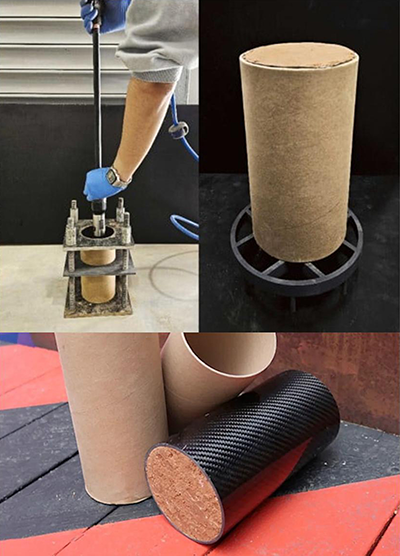
On the other hand, RMIT’s cardboard-confined rammed earth uses heavy cardboard cylinders created from cardboard waste diverted from landfills. This form-like confinement eliminates the need for cement. As a result, the process involves only one quarter of the carbon footprint compared to concrete, at less than one third the cost. Adding carbon fibre reinforcement proved to further boost the finished strength to that rivaling high-performance concrete.
This is exciting news for construction in remote areas with limited access to building materials, or where shipping such materials could be prohibitively expensive.
The cardboard-confined rammed earth can be made onsite by compacting the local soil and water mixture inside the cardboard formwork, either manually or with machines.
“This would significantly cut transport costs, simplify logistics and reduce upfront material demands,” said RMIT emeritus professor Yi Min Xie, a study corresponding author and leading expert in the field of structural optimization. It would also open the door for the use of local labour.
Ma and the RMIT team said they are ready to partner with various industries to further develop this new material for commercialisation and wider use.
John Bleasby is a freelance writer. Send comments and Inside Innovation column ideas to editor@dailycommercialnews.com.


Recent Comments
comments for this post are closed